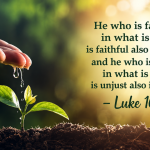

As we continue with the series ‘ruler over many,’ we are reminded that we must first prove ourselves faithful as stewards before we can be entrusted with greater responsibility and ownership. Saints, faithfulness is the power of promotion, and we must uphold it regardless of the circumstances. The Apostle Paul emphasizes this principle, saying, “it is required in stewards that one be found faithful” (1 Corinthians 4:1-2). This applies both in ministry and the marketplace: we must be faithful in whatever we do, knowing that our service is ultimately unto the Lord (Colossians 3:23-24). So this week, we learn from Jacob’s life how diligence and wholehearted service prepare us for greater responsibility and reward.
In Genesis 29, as Jacob was travelling to Haran, he found shepherds waiting for the other flocks to gather before together rolling the stone away from the well (vs.1-3). However, when he saw Rachel approaching with her father’s sheep, Jacob went and rolled the stone away himself and watered the flock (vs.6-10). What the shepherds had been waiting to do together, Jacob accomplished on his own. His actions demonstrate initiative and capacity; the ability to recognise what needs to be done and take responsibility rather than waiting for someone else to act. Faithful people are proactive; they identify opportunities to bring value even before they are formally asked or rewarded.
We see these qualities in Jacob after he had been staying with Laban for a while, serving faithfully even before any wages had been agreed upon (vs.14). Laban recognized Jacob’s efforts and asked him, “Because you are my relative, should you therefore serve me for nothing? Tell me, what should your wages be?” (vs.15). When Jacob agreed to serve seven years for Rachel (vs.18), those years seemed to him like only a few days because of his love for her (vs.20). Church, there is a difference between merely working to fulfil an obligation and serving with purpose. Ephesians 6:5–8 teaches us to serve sincerely “as to the Lord, and not to men,” knowing that the Lord sees and rewards the good we do. Whether in ministry or the workplace, we must be faithful, available and teachable. Our diligence should not depend on whether our leaders are watching or whether we receive immediate recognition; instead, our commitment must come from our reverence for God.
It is crucial to understand that faithfulness does not excuse us from facing challenges. Jacob too experienced disappointment and unfair treatment though he had proven himself faithful. After working the seven years, Laban deceived him by giving him Leah instead of Rachel, requiring him to serve another seven years for Rachel (vs.21-30). Despite this, Jacob continued to fulfil his responsibilities with integrity. Saints, we may encounter difficult leaders or unfair circumstances, but we must never allow these experiences to make us unfaithful. God sees our labour, even when others fail to acknowledge it, and He will restore us in His time. As Matthew 6:4 reminds us, our Father, who sees what is done in secret, will reward us openly. So, let us not lose heart; let us continue doing what is right, trusting God even when the process takes longer than we expected.
We see the fruit of Jacob’s faithfulness in Genesis 30. When he sought to provide for his own household, Laban asked him to stay, acknowledging that the Lord had blessed him because of Jacob (vs.27–28). What a testimony! We too should strive to be people whose faithful contribution is recognised and valued, rather than those whose departure from an organisation brings relief to the people they serve. Eventually, Laban agreed that Jacob would receive a share of the flock instead of wages (vs.29-34). Jacob then applied divine innovation in managing the flock, and his possessions increased greatly (vs.37-42). In fact, Scripture records that “the man became exceedingly prosperous” (vs.43). Though Jacob started out as a servant, his faithfulness promoted him to ownership. Even Laban’s sons recognised his prosperity, saying, “Jacob has taken away all that was our father’s, and from what was our father’s he has acquired all this wealth” (Genesis 31:2). This was yet another biblical principle at work: “the wealth of the wicked is stored up for the righteous” (Proverbs 13:22).
In Genesis 31, we see another turning point in Jacob’s journey as God directed him concerning his departure from Laban. This reminds us that faithfulness does not mean remaining in the same place forever; we must also remain sensitive to God’s leading on when to move. Even when we serve under difficult leadership, we are not abandoned by God; He is right there with us, working together all things for our good (Romans 8:28). So saints, let us remain faithful in the assignments entrusted to us, serving wholeheartedly even when no one is watching, trusting that God sees our labour and knows when it is time to lead us into a new season. Hallelujah!
Prayer
Heavenly Father, help us to be faithful stewards in all You have entrusted to us. Give us the wisdom and capacity to bring value wherever we are and remain faithful even when our efforts are seemingly unrecognised. May we be faithful in the little so we can be trusted with more, doing all to bring glory unto Your name. In Jesus’ name, Amen.